
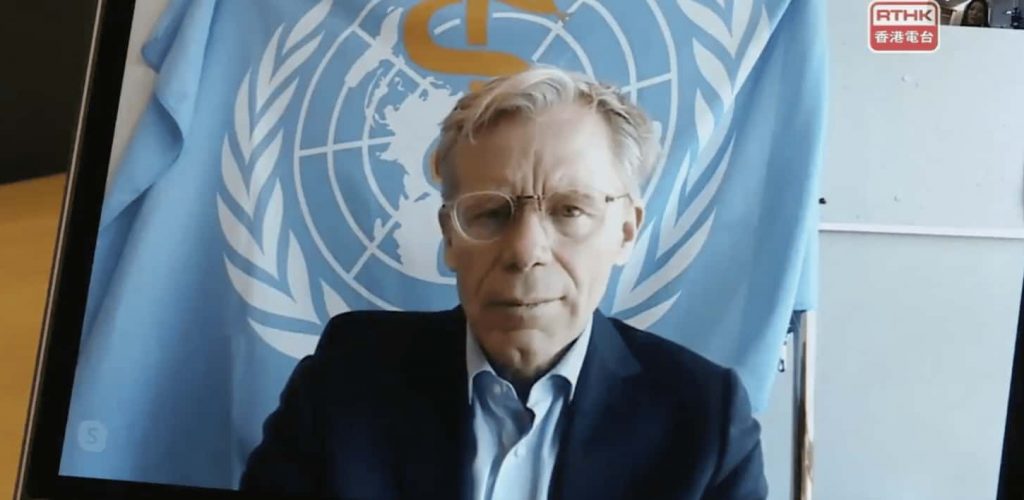
The video of a representative of the World Health Organization hanging up on a reporter for asking questions about Taiwan’s response to the Covid-19 outbreak quickly spread around the world on Saturday. The Hong Kong reporter, Yvonne Tong, was asking questions of Bruce Aylward, a Canadian doctor. From The Guardian:
Asked by the RTHK reporter, Yvonne Tong, if the WHO would reconsider Taiwan’s membership, Aylward didn’t respond for several seconds, before saying he couldn’t hear the question.
Tong offered to repeat it but he cut in: “no, that’s OK, let’ move to another one then.”
“I’m actually curious to talk about Taiwan as well,” Tong said.
Aylward then appeared to either hang up the call, or get disconnected.
This is truly one of the most embarrassing, self-inflicted PR disasters in recent memory (and not just because he hung an oversized WHO bath towel behind him).
After the ‘disconnection’, the RTHK reporter did the right thing and called him back:
Tong asked if he could comment “on how Taiwan has done so far in terms of containing the virus”.
Aylward responded: “Well, we’ve already talked about China. And when you look across all the different areas of China, they’ve actually all done quite a good job.”
“With that I’d like to thank you very much for inviting us to participate,” he said, ending the conversation.
I am almost shocked that this happened in 2020. How on earth can a large, international organization like WHO put somebody on television in the middle of a global pandemic who acts this way? Who’s responsible for giving him the green light?
There is a lot of apprehension inside organizations about who can speak to the press, precisely to avoid this kind of situation. Aylward didn’t talk to the reporter for long, but it was long enough to deliver a massive body blow to WHO. There is already so much skepticism – and criticism – about how WHO has handled the outbreak, its relationship with China, and its refusal to deal with Taiwan. Ignoring a reporter’s question and hanging up the phone is something a guilty person does, and it confirms people’s worst fears about how the organization operates.
That alone made the interview a disaster, but there’s more. Aylward claimed he didn’t hear the reporter’s question about Taiwan, leading to a few seconds of awkward silence (which felt like a full minute). But when Tong began to ask it again, Aylward cut her off and suggested she move on to the “next one”, basically admitting he lied when he said he didn’t hear the question. Already deep in a hole, Aylward decided to keep digging.
When I’m asked why companies need PR people, this serves as exhibit A. Most of the time things go smoothly, but when a crisis hits it’s critical for the response to be fast, professional, and accurate. The wrong move can severely damage an organization’s reputation, trust, and ultimately its bottom line. I can’t begin to fathom how the PR department signed off on Aylward’s appearance unless his ‘hang up’ is the first time he’s done something like this in his 20 year career at WHO (extremely unlikely).
Going on live television to answer pointed questions isn’t easy; after all, Aylward is a physician, not a spokesman. So I do have some sympathy for the guy. If he felt uncomfortable speaking publicly, he should have said something in advance (and maybe he did). He made a mess of the situation, but it’s the PR team that is ultimately responsible. Its job – its most important job – is to protect WHO’s reputation. They are paid a lot of money to avoid exactly this situation.
This was a colossal failure on multiple levels and will do lasting damage to WHO’s already suspect reputation. The organization knows it, too, because they’ve removed Aylward from the executive team on its website.
The awkwardness begins at 19:56. Enjoy.