I can’t believe I haven’t mentioned this yet, but I’ve teamed up with a good friend of mine to launch a new podcast that focuses on PR and law named, naturally, the PR & Law Podcast.
I’m still not entirely comfortable with the result; it has been more than a decade since I’ve done any kind of radio, which remains my first love. I am having an absolute blast working on the podcast, but we still have plenty of kinks to work out and refinements to add.

The video of a representative of the World Health Organization hanging up on a reporter for asking questions about Taiwan’s response to the Covid-19 outbreak quickly spread around the world on Saturday. The Hong Kong reporter, Yvonne Tong, was asking questions of Bruce Aylward, a Canadian doctor. From The Guardian:
Asked by the RTHK reporter, Yvonne Tong, if the WHO would reconsider Taiwan’s membership, Aylward didn’t respond for several seconds, before saying he couldn’t hear the question.
Tong offered to repeat it but he cut in: “no, that’s OK, let’ move to another one then.”
“I’m actually curious to talk about Taiwan as well,” Tong said.
Aylward then appeared to either hang up the call, or get disconnected.
This is truly one of the most embarrassing, self-inflicted PR disasters in recent memory (and not just because he hung an oversized WHO bath towel behind him).
(more…)Editor’s Note: An update to this story has been included at the end.
The Covid-19 pandemic got serious in North America last week when big events started to be called off to prevent person-to-person transmission of the virus. The NBA was the first of the major sports leagues to suspend the season after Utah Jazz player Rudy Gobert tested positive for Covid-19 on Wednesday night, minutes before tipoff between the Jazz and Oklahoma City Thunder. The NHL followed about 15 hours later, announcing Thursday morning that the NHL season would go on “pause”. Then it snowballed: the MLS, Major League Baseball, Broadway, NASCAR, and other events were all suspended with some, like the NCAA “March Madness” basketball tournament, canceled outright.
Even though sports executives have known about the coronavirus since January, nobody expected sports leagues to suspend their seasons. It’s a drastic step that brings huge consequences both financially and logistically. In a way, the leagues had no choice, as they relied on information from health officials and had to do whatever it takes to stop Covid-19 from spreading further. Stopping the regular gathering of 20,000 people in arenas across the continent seems to be rather obvious!
A crisis like this can provide excellent public relations case studies. Some organizations have come forward with clear and compassionate communications with their season ticket holders, fans, and employees, while others — ahem, Mark Chipman — have badly missed the mark.
(more…)I worked in China’s state-run media machine way back in the mid 2000s, so I’ve seen how the authoritarian propaganda sausage is made — and it’s not exactly sophisticated (or appetizing, if we extend the metaphor). Chinese leaders have a monopoly on information in China so it’s relatively easy to get messages out to a domestic audience, but winning over people outside China — many of whom have been taught to be skeptical about media messages generally — has consistently proven to be a mountain too high to climb.
I’m no flag-waving fan of the Chinese government, but I’ve argued before that it’s not all bad. There are some legitimately good stories to tell about the country’s development, and on some hot-button issues China’s side rarely gets told. This is an institutional failure: the party controls the media, so the media must work to make the party happy for staff to keep their jobs and continue getting paid. That makes party officials the primary audience, and nothing makes Communist masters swell with pride like schmaltzy nationalism on TV. Rinse, repeat, and here we are today with Chinese propaganda stuck in the Soviet era.
Up until 2016, the US had traditionally been quite mindful and sensitive when dealing with China; both sides recognized the importance of the relationship and understood that conflict – hot or cold – could be catastrophic. The election of Donald J. Trump as US President blew that approach out of the water, and China’s media apparatus has proven to be ineffectual in operating in this new, social media-driven, acerbic international PR environment.
The South China Morning Post has an excellent piece looking at China’s media troubles and asks this question: is China’s propaganda machine losing the public relations battle with the US? The answer, in my view, is yes.
“…while US President Donald Trump has tweeted about China more than 100 times since the start of the trade ar last July, the Chinese government has been far quieter.
Analysts say this communication asymmetry has allowed the US to dominate the trade war narrative, as Beijing relies on its carefully managed state media coverage for its side of the story, which struggles to engage international audiences.
The hurdles for the bureaucratic Chinese propaganda machine centre on its lack of understanding of the Western public, restrictions for coverage to toe the official line, and existing preconceptions about China.”
I live in Hong Kong and get a steady, daily diet of China news, and yet I’m not sure I could explain China’s argument against US accusations of intellectual property theft, for instance. The US media – and the President himself on Twitter – has done an admirable job of hammering away on China, repeating US complaints incessantly and winning broad support, while Chinese media have been slow to respond. It can take days to work out an official response, which frequently comes across as clumsy and ineffective. (Frequent attempts to come up with catchy phrases or insults is truly cringe-worthy.)
China’s amateur, unsophisticated messaging and dithering over the “correct” way to report the news is quite literally harmful to the country’s national interests.
China’s achievements over the past 30 years – the rapid growth of the economy, establishment of a huge middle class, re-invigorated military, national prestige – shouldn’t be discounted. But in a way, that was the easy part: China was mired in poverty and traumatized by the Cultural Revolution when Deng Xiaoping decided it was time to let the cats catch mice. Unleashing capitalistic instincts and leveraging a massive population to build a globally-competitive manufacturing sector was a logical next step and made a lot of sense — but now what?
China has long resisted western forms of communication, culture, and governance, but the reality is state media must learn how to communicate effectively and win support from stakeholders outside of China. If it doesn’t, it risks threatening the very culture and form of government it aims to protect.
The country is no longer an underdog; it’s operating in countries around the world, strengthening its military and becoming more assertive in protecting what it considers national interests. It has made clear its ambition: not only be a power alongside the United States, but to exceed it. It can’t pull that off without a slick, nimble, sophisticated media machine capable of making a case, winning arguments, and persuading people around the world. China’s amateur, unsophisticated messaging and dithering over the “correct” way to report the news is quite literally harmful to the country’s national interests.
Donald Trump is despised among huge swathes of the world, even picking fights with long-time allies. There is potential for China to capitalize on the mistrust of the US president, make a compelling case for itself, and ramp up cooperation with countries feeling insecure with the messages coming out of Washington. China’s failure to make any headway is a sign of how far it still has to go.
I had the privilege of talking to communications students this morning at Hong Kong Polytechnic University. People who know me will be aware that I don’t have a university degree, but rather a diploma from the British Columbia Institute of Technology. The story of how that happened can be saved for another day — but suffice to say, I managed to skip the university lecture ritual in my early 20s, making it quite ironic that I found myself speaking to students who were in their master’s degree program.
I’ve given many, many presentations over the years but this was the first time I had to stand and speak for three whole hours. There’s a coffee break in there too, but it’s negligible. I worked on the presentation last night until quite late, finally wrapping up with 85 slides plus some live poll questions.
The lecture itself was called Digital @ Work & Play, and introduced the students to digital communications within a corporate setting, as well as how to build a personal brand and some key, “secret” tools to help make that happen.
I received a number of questions afterward, focused almost entirely on the software tools used to help create content, grow audiences, and measure the success or impact of any given campaign. I’ve realized over the past few years that while everyone knows all about Facebook, WeChat, and Twitter, few are aware of some of the cutting-edge tools that make content creation easier than ever before. The gap isn’t so much in capability but in the knowledge of what’s out there. I’m reluctant to share too many details because it would blow my cover!
I enjoyed the session even more than I thought I would, but the reaction to one slide surprised me. It’s a slide that clearly struck a nerve because a few people mentioned it to me afterward. It was this:
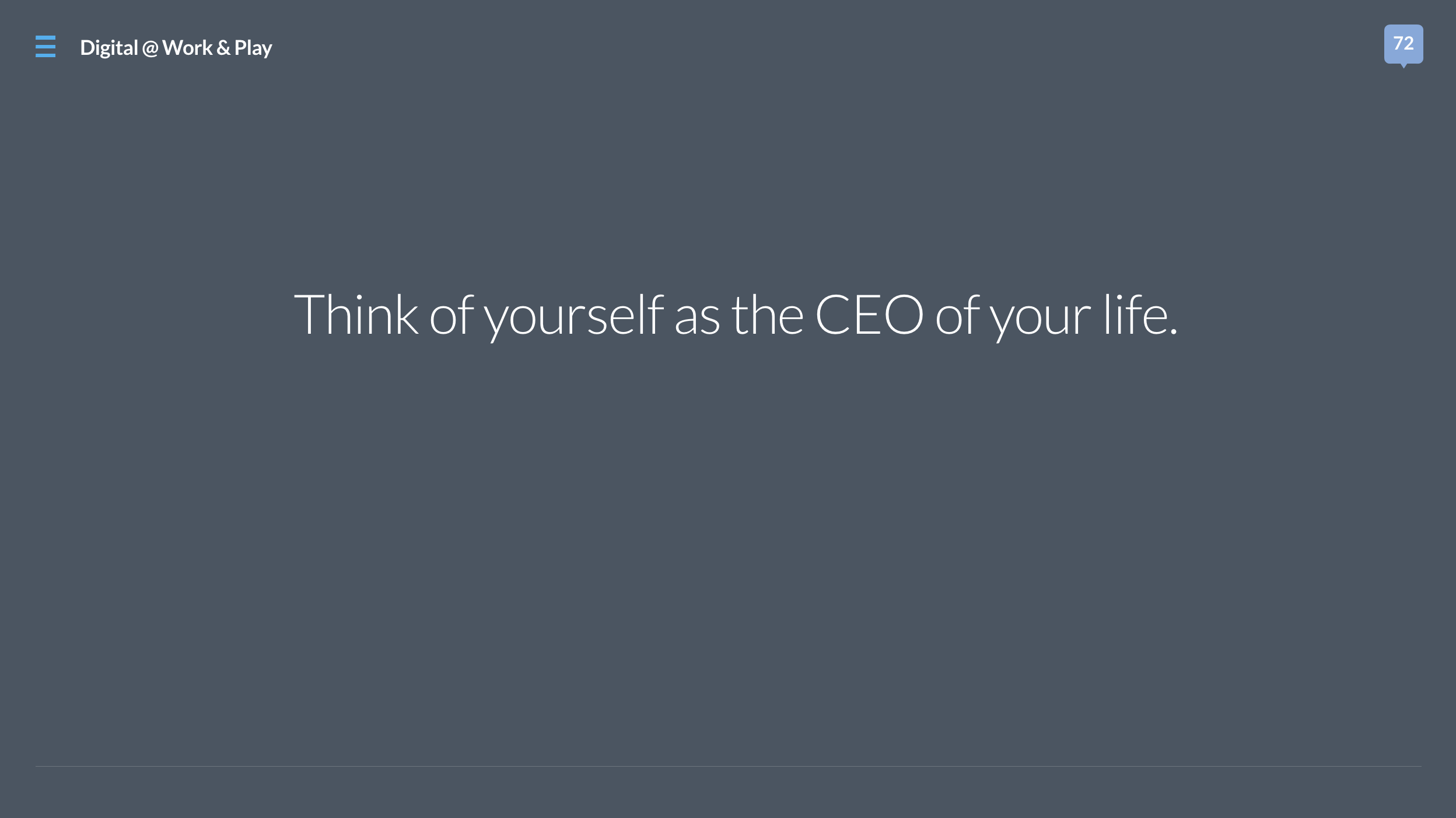
I’m not even really sure why I included this slide, but in retrospect I’m really glad I did. I have been thinking this way for a long time, as people who know me personally would attest.
I do think of myself as the CEO of my own life, and like I told the students, you should look back at the work of the CEO at year’s end and decide if the CEO deserves a contract extension or needs to be replaced. Based on the goals set at the start of the year, one’s age, and one’s personal circumstance is the CEO doing a good job? Is the CEO managing risk properly? Putting in contingency plans? Growing the business? Getting results? Or has the CEO missed some opportunities? Made some bad decisions that hurt the business?
It can be an eye-opening and often uncomfortable experience asking these questions of oneself if they’re considered honestly. In a way, this one slide could be more important than the other 84 combined, because it applies to everyone.
Overall I really enjoyed the session — the students were curious and it was great engaging them in discussions and helping answer their questions. I was a bit nervous preparing for such a long talk, but it went better than I thought it could. I’ve already been asked back to do it again for new students next semester, and I’m looking forward to it — particularly because I can recycle my deck! ????
As a PR flak I hear the jokes about my profession, and I’m not above tossing a few zingers myself. PR people don’t get much respect, and Sean Spicer certainly hasn’t helped. But there are times when people in my line of work truly earn their salaries; when a crisis of epic proportions hits that has the potential to upend a company or entire industry. Think the BP Horizon oil spill from the Gulf of Mexico in 2010 or the Volkswagen emissions fiasco from 2015.
The violent removal of a passenger sitting on board a United Airlines flight is another cataclysmic event for a public company. It will deeply wound all airline companies and is so disturbing that few (but there are a few) are able to defend it. The video, which has been flung around the world online, is gutwrenching, and leaves the viewer with searing anger at the violent injustice against an innocent man who could be any one of us. It’s personal. This is disaster with a capital D, and United, somehow, failed to recognize it.
I am traveling the Scottish highlands at the moment, so haven’t been tuned to the incessant cable news chatter, website tirades and newspaper inches that I’m sure have been dedicated to the story. But what has stood out from a distance is the massive PR fail from United, which took a seriously bad situation and turned it into a complete disaster. Good communications can rarely get a company ‘off the hook’, so to speak, but it can help make the company more relatable and lessen the intensity of the anger. United Airlines did the opposite, and its response will be in textbooks for years to come as a case study in what not to do.
So let’s break this down. Here is what United Airlines issued on April 10, shortly after the incident:
“This is an upsetting event to all of us here at United. I apologize for having to re-accommodate these customers. Our team is moving with a sense of urgency to work with the authorities and conduct our own detailed review of what happened. We are also reaching out to this passenger to talk directly to him and further address and resolve this situation.”
As the Financial Times noted, this looks like a canned response that could have been used in the event of a blizzard. In a crisis, the first thing to do is understand public sentiment; that is, get on the same emotional plane before crafting a response. In this case, people around the world were shocked, angry, and ready to march on United Airlines with pitchforks. United instead focused on the inconvenience of having to “re-accommodate customers”, which was so far off point I’m shocked it passed through United’s PR and executive teams. I don’t think the re-acommodation of passengers is what lit a fire under millions of people worldwide (but call me crazy). The first response in a crisis is the most important; it needs to accurately reflect the severity of the incident and try and diffuse it. By responding with empty platitudes, it made people feel like United was brushing it off, making them hate the airline even more.
Instead, United might have issued something like this:
“We are absolutely shocked about what happened on board Flight 3411. Nobody, under any circumstance, should be removed from an aircraft in such a violent way. We are deeply disturbed by this event and will conduct a thorough review of our policies and procedures to ensure this never happens again. We offer our sincerest apologies to the passenger, and all other passengers on board United Flight 3411 who witnessed this horrific incident. We know you expect more from us, and we promise to get to the bottom of what happened.”
United Airlines CEO Oscar Munoz then issued a letter to all staff. This is more difficult, because he is writing to address two distinct stakeholders: UA staff and angry customers. (He surely must have known the letter would leak). Unfortunately he failed on both counts:
“Dear Team,
Like you, I was upset to see and hear about what happened last night aboard United Express Flight 3411 headed from Chicago to Louisville. While the facts and circumstances are still evolving, especially with respect to why this customer defied Chicago Aviation Security Officers the way he did, to give you a clearer picture of what transpired, I’ve included below a recap from the preliminary reports filed by our employees.
As you will read, this situation was unfortunately compounded when one of the passengers we politely asked to deplane refused and it became necessary to contact Chicago Aviation Security Officers to help. Our employees followed established procedures for dealing with situations like this. While I deeply regret this situation arose, I also emphatically stand behind all of you, and I want to commend you for continuing to go above and beyond to ensure we fly right.”
There is so much wrong with this, I don’t know where to start.
The word “upset” doesn’t nearly come close to understanding and reflecting the vitriol and disgust people felt after watching the video. People get “upset” when the chicken is gone and only beef is left. Again, Munoz failed to grasp the seriousness of the issue.
Then this: “…with respect to why the customer defied the Chicago Aviation Security Officers the way he did…”. This makes it seem like it was the man’s fault. While there may be some truth to the fact he did defy officers, this isn’t the time or the place to mention it. It goes against the general mood and comes off as petulant and defensive. This is something for another time, not a letter to staff within hours of the incident and when the world is watching.
This: “Our employees followed established procedures…”. This is when Munoz is trying to serve two masters. He is correctly trying to show support for his staff, but it comes off as tone-deaf to the public. If “following established procedures” means an innocent man is knocked out in a violent confrontation and has blood dripping down his face, then perhaps the procedures need changing.
Finally: “…I want to commend you for continuing to go above and beyond to ensure we fly right.” This sounds like something taken out of a promotional pamphlet, and again is completely tone-deaf. It’s obvious to everyone that United Airlines didn’t “fly right”, much less “ensure” it’s so. Munoz is caught again between the two stakeholders, but surely even his staff felt the vacuousness of these words. Munoz only needed to say that the situation is deeply disturbing, he apologizes that his staff needed to live through this, remind them they do a great job day to day, and let them know he’s going to get to the bottom of it so they never have to be put in that situation again. That’s it.
Oh, and by the way: at this point Munoz still hadn’t apologized to the guy who was knocked out and dragged off the flight — you know, his paying customer.
I’m not sure what happened after this letter, but Munoz must have gotten some new communications counsel. His next media statement, issued on April 11, comes much closer to hitting the mark:
“The truly horrific event that occurred on this flight has elicited many responses from all of us: outrage, anger, disappointment. I share all of those sentiments, and one above all: my deepest apologies for what happened. Like you, I continue to be disturbed by what happened on this flight and I deeply apologize to the customer forcibly removed and to all the customers aboard. No one should ever be mistreated this way.
I want you to know that we take full responsibility and we will work to make it right.
It’s never too late to do the right thing. I have committed to our customers and our employees that we are going to fix what’s broken so this never happens again. This will include a thorough review of crew movement, our policies for incentivizing volunteers in these situations, how we handle oversold situations and an examination of how we partner with airport authorities and local law enforcement. We’ll communicate the results of our review by April 30th.
I promise you we will do better.
Sincerely,
Oscar ”
A few things I liked about this:
- He gets the severity. “Truly horrific event”, “outrage, anger, disappointment”. He’s communicating that he gets it.
- He finally apologizes to the customer.
- He takes responsibility.
- “It is never too late to do the right thing.” This is key, because it shows humility and is a tacit admission that things (including communications) haven’t been done properly. We are all more willing to forgive somebody with a dash of humility and an earnest desire to improve.
- He is taking action: he details what will be covered in the review and when it will be concluded.
The situation is still evolving and there is plenty of time for further screw-ups, but it seems United might finally be on track in terms of communications. Whatever happens from here on out, the case of Flight 3411 will be studied by in-house communications teams around the world.
A few more points, unrelated to communications:
Overbooking
This case has shone a light on the issue of overbooking, which airlines have been doing for decades. Ironically, the problem on Flight 3411 was not overbooking, but the need for United Airlines’ own staff to travel. Overbooking may be a problem that deserves attention, but in my view this is much worse: no paying customer should be taken off a plane to make room for staff traveling for free, ever. It is the airline’s responsibility to get staff to where they need to be; asking paying customers to sacrifice for them is completely offside. Imagine a restaurant saying they can’t serve food because their waiters need to eat it, or Disneyland staff cutting in line because they need to experience Pirates of the Caribbean, too.
Denial of boarding
Several stories note that airlines can deny boarding (according to the terms and conditions of the ticket) if they choose. In fact, the rules give airlines a wide berth to deny boarding; what seems lost in this argument is David Dao, the Vietnamese-American doctor, wasn’t denied boarding. He was already sitting on the plane. I am not a lawyer, but to me this raises other questions: can an airline force a fully-paying passenger, already seated, off a flight without cause?
Fallout for other airlines
All airlines are stressing about overbooking and treatment of customers following this incident. It is a sensitive time in the industry, when even the slightest misstep could trigger an avalanche of complaints and anger. The public mood toward airlines is dark.
Service with airlines (particularly American ones; Asian carriers figured out proper customer service long ago) has been in serious decline for years, and the public has so far been able to grin and bear it. But after this, there’s no guarantee customers will continue to be so forgiving. United Airlines Flight 3411 has the potential to upend the entire relationship between airlines and their customers, and that would be a silver lining to an otherwise despicable incident.