First off, happy new year! I haven’t been blogging too much recently, but will attempt to increase the frequency in 2024. I am not calling it a “resolution”, as that word implies commitment. It’s much too heavy a word. It induces mild anxiety! So instead, I’ll simply try to pop up here more often. Does that work?
People are always recommending podcasts to me, as they know I devour them whenever I can. Friends and co-workers often remark that I’m easy to spot in a crowd because I’m always wearing my headphones — whether it’s walking to work, heading for lunch, hiking, on airplanes, you name it. I have my podcast favorites, some I dabble in depending on the episode, and a few others that somehow ended up in my queue but I’ve never listened to. Darknet Diaries was one of those.

Each episode of Darknet Diaries looks at a security-related incident like an online scam, phishing attempt, crypto-crime, or penetration testing, the art of trying to access a building or server without authorization. Companies will often hire hackers and “pen testers” to find weak points in their security, often leading to precarious situations.
Darknet Diaries is hosted by Jack Rhysider, a guy whose previous career in cyber-security enables him to break down issues and make them understandable to the layman (i.e. me). He’s a superb storyteller and comes across as casual and conversational, never talking down to the audience and always making sure they’re following along.
If this sounds good to you, dive in with any episode — I haven’t found a bad or boring one yet. But for an extra treat, I was fascinated by the story of a former criminal named Gollumfun (who is active on X). Those are episodes 128 and 129. As they say, you can find the show wherever you get your podcasts.
Let me know what you think.
One of my nerdier goals during the Christmas break has been cleaning up my messy and discombobulated news ecosystem. I’ve used RSS regularly for a long time, so that’s naturally picked up some cruft in recent years. Throw in a plethora of Substack newsletters and links scattered across various ‘read later’ apps, and you see the potential for some serious link chaos.
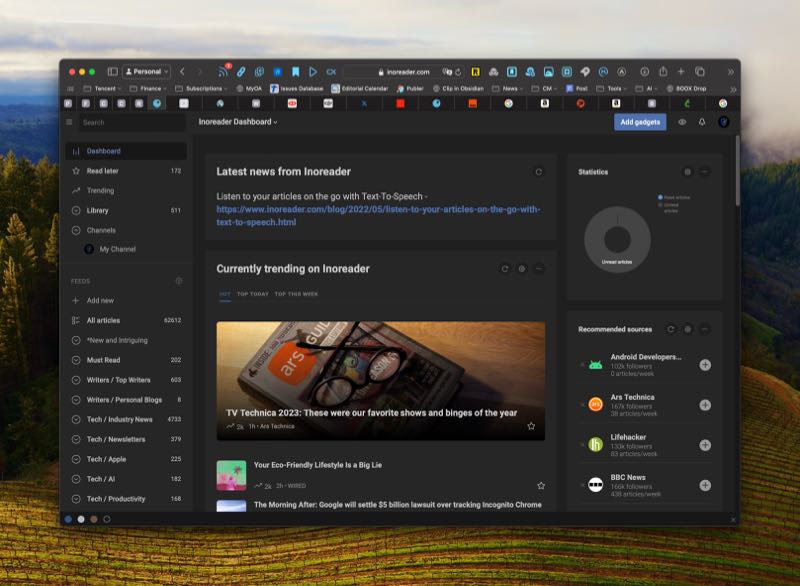
The first step was to clean up my feeds in Inoreader, which I’ve mostly done. Inoreader remains the most powerful RSS reader on the market, packed with features for power users. I make good use of the highlighter, rules, tags, and filters. I’ve even combined RSS feeds to create new ones that I can use elsewhere. If you just want to track a few blogs, Inoreader is probably overkill; but if you want to slice and dice through the information overload, Inoreader is among the best ways to do it.
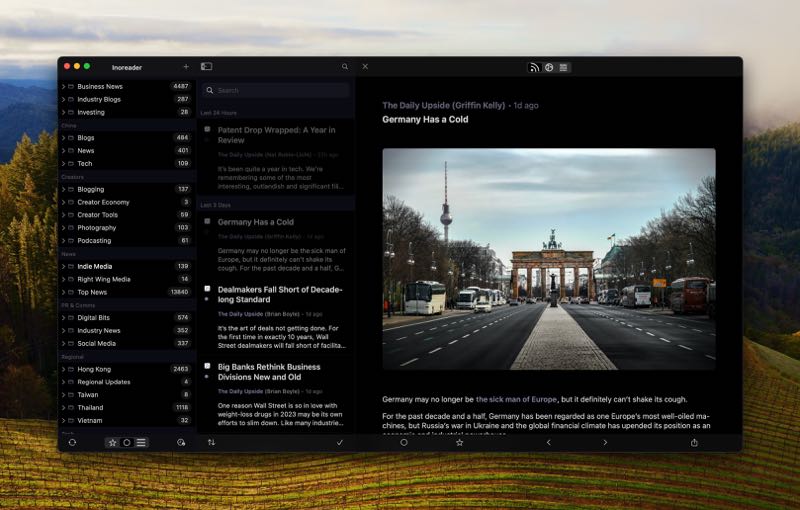
Several years ago I also loved Fiery Feeds, a boutique app available across Apple’s platforms. I remember loving the app, but running into bugs frequently enough that it soured on me over time. And to be honest, I’ve never quite felt right about RSS since then. So after I cleaned up Inoreader, I decided to connect it to the Fiery Feeds app on MacOS, iOS, and iPadOS and give it another shot — and I’m in love.
I had forgotten how clean and streamlined the app is. Fiery Feeds brings over saved searches, tags, and other features of Inoreader, while adding the ability to create “sections”, which can be groups of folders, feeds, or both. I’ve always wanted at least one or two levels down of nested folders, and this feature scratches that itch.
Fiery Feeds also offers granular control over how the app looks and functions, including text font and sizes across various different views, whether you want a one, two, or three-pane view, what left and right swipes will trigger, and which apps to integrate as sharing options. I’ve only started using Fiery Feeds again for the past few days, and so far it’s been totally bug free. Things are efficiently clicking along for me again for the first time in years. It’s lovely!
After I got everything up and running, I decided to dig into some more complex automations. For instance, I connected Zapier and the app Pushcut to deliver urgent notifications to my phone if a news article met a certain set of criteria. I also opened a Telegram Channel and automated a custom news feed directly into the channel, and so far it’s working great. If there’s any interest in how I’ve set this up, let me know below (or ping me on X, Mastodon, Threads, or Bluesky) and I can throw together a tutorial.
Next, sorting through the various ‘read later’ apps I’ve tried over the years, which now includes Goodlinks, Omnivore, Cubox, Anybox, Articles+, UpNext… (hey, for some people, trying every notes app is their thing — don’t judge)
The pandemic lit a fire under people to improve their home work setups, including how they come across on Zoom calls. I remember in the early days of the pandemic finding a video that explained how to make a simple teleprompter for use during video calls, because they enable constant eye contact with the audience while still looking directly at a monitor so you can see everyone else.
If you’re interested, I might do a walkthrough of the whole process. I took that initial idea and tweaked it a bit to make it even better. One of those improvements was getting a thinner, but bigger, display that would be reflected off the teleprompter glass. This created a problem, though: the reflected image appears backwards.
(more…)I’m one of those people who basically leaves AirPods in their ears 24/7 — but in my case, it’s not usually for music. I’ve become a certifiable podcast addict with a wide-range of shows in my queue — everything from discussions about the Vancouver Canucks to productivity software to Saturday Night Live (definitely check out Fly on the Wall if you’re an SNL fan).
Amid that sea of shows, one really stands out: Heavyweight. If you haven’t listened before, do yourself a favor and head over to Spotify right now (yes, unfortunately it’s a Spotify exclusive) and treat yourself.
My description won’t do the show justice, but I’ll try: each episode involves going deep into somebody’s past to “the moment everything changed.” It could be an issue that still nags at a person many years later, or unfinished business, or some mystery from the person’s past that they want resolved. Ultimately, they want peace of mind.
Heavyweight is hosted by This American Life alum Jonathan Goldstein (a fellow Canadian!), who has evolved into an absolute master storyteller. In fact, Goldstein was interviewed earlier this year on the Longform podcast, where the hosts called Heavyweight the best podcast out there.
The show is seasonal, with new episodes coming this fall. In the meantime, dive into the back catalog as the shows aren’t time sensitive. I’ve also included an interview featuring Goldstein below, but don’t watch it yet. Listen to a few episodes first, and then come back. You’ll get much more out of it.
Enough of me pontificating. Just trust me on this one — go have a listen. Now.
I’ve gone down the rabbit hole of cameras and audio equipment over the past year, which has led me to establishing a new personal challenge: documenting trips in a more creative and compelling way. I’m officially an ‘old’, so still post still photos to Instagram and think that’s sufficient. And while I have no designs on becoming a full-time Tik Tok’er, I do want to do a better job of documenting these moments for myself to look back on someday.
That’s a long-winded way of saying I recently impulse-purchased my first 360-degree camera, the Insta360 X3. It’s a nifty little device that won’t win any video quality awards, but it does give the user (me) the peace of mind of knowing that it’s shooting footage everywhere. No need to point a 360 camera at anything, because it’s capturing everything.
After picking up some things at the grocery store, I decided to pull out the camera on a tuk tuk ride back to the condo. It’s not a slick video by any means, but I think it captures the moment.
Let me know what you think.
There are a million lists of ‘travel hacks’ out there and I almost never share them, but for some reason I figured I’d pass this one along. It’s a list of 45 tips, some of which will be new to even the most seasoned traveler.
A few of them I already do, like roll clothes in a suitcase rather than fold and pack them. Another one is to bring food on board, especially if you’re flying economy. I’ve opted for a Subway sandwich from Vancouver airport many times before boarding, and my fellow passengers usually give me longing looks as I unwrap it while they dig into their soggy broccoli.
One of these tips genuinely surprised me, though: frozen items are permitted through security. We’ve all been caught, usually accidentally, with a water bottle in our carry-on luggage while passing through security. People either chug the water like it’s a high school beer, or just pass it to the security agents. However, if that same bottle of water was frozen, you’d get through with no trouble at all. Who knew?
If you’d like to pick up a few more ideas, or just miss traveling and want to pretend like you have a trip coming up, then dig in.
Sometimes I wonder, with political polarization so extreme in the United States and elsewhere, how we’ll be able to work together to solve actual problems. Most days can seem pretty depressing.
Fortunately, though, one guy may have stumbled on the answer: by laughing at the absurdity.
I had not heard of the group “Birds Aren’t Real” before, and I almost didn’t listen to an episode of The Daily that teased the content by describing it as “fighting misinformation with misinformation”. But I’m glad I did.
If we are going to be saved from the mess we’ve made, it will likely be by brainy Gen Zers like Peter McIndoe. If you want a laugh — and a bit of hope — you can read about him in a feature in the New York Times. If audio is your thing, then don’t miss this episode of The Daily.
Trust me, it’s worth it.
When it comes to the battle against COVID-19, things in Hong Kong are falling apart fast.
Most of the developed world is reaching a grudging conclusion that SARS-CoV-2 will be with us for a long, long time, and have begun to slowly lift restrictions where appropriate. It’s too early to say the end of the pandemic is near, but at least there is room for optimism.
(more…)I often joke with friends — well, half joke — that phone calls are rude. Not all phone calls, of course, but those that come without any warning.
I’m a person who loved getting phone calls when I was younger, but growing up means getting busier. It means filling up one’s day with responsibilities, meetings, work, exercise, chatting with a loved one, or whatever else. I don’t pretend to be busier than the next person, but we all have things to do.
In this context, phone calls are just plain rude. Think about it — we don’t show up at people’s houses unannounced, because we don’t know if now is convenient for them. Unless it’s a close friend or relative, people would usually schedule a visit in advance. Right?
A cold call is the equivalent of the person showing up and banging on your front door without warning. Now, imagine you just settled into a bath when the doorbell rings. Or maybe you’re reading a story to your kids, watching a movie, or just learned a relative passed away. Or, imagine you are sitting in a formal meeting at work, and a buddy bursts in because he wants to talk to you right now. We would never tolerate these things, because they are disrespectful; at least, I couldn’t imagine doing that to somebody else.
In an age of ubiquitous mobile phones and practically free text messages, why not a quick note first? It’s just a nice thing to do, isn’t it?
Thankfully it seems most people have embraced the pre-call text message, at least in my own small circle. But if you’re still dealing with friends dialing you up without warning, designer Dan Mall might have a solution. He’s created an iPhone mockup that gives users a heads-up about the nature of a call before they answer.
From 9to5Mac:
In his concept, Dan imagines that could be a “new interim screen before the call starts that prompts you to add a subject for the call.” In his case, he’s calling someone about “Visiting Westview this weekend.” Not only is it a pretty cool idea, but would also save us time when someone calls you about “that talk.”
On the receiving end, Dan notes, the person can preview the subject of the call to decide whether or not they want to take the call right now.
It wouldn’t necessarily end unannounced calls, but at least the receiver could determine whether to answer or not. It’s a step in the right direction.
As nice as the idea sounds, though, I give it about zero chance of ever happening. If cold callers can’t be bothered to message first, it’s unlikely they’ll take the time to fill out a subject field.
Ed Luce, one of my favorite writers at the Financial Times, looks at how English-speaking democracies have been battling Covid. Australia, New Zealand, and Canada are doing decently well, but the other two aren’t:
The pandemic record of these three English-speaking democracies belies the notion that “Anglo-Saxon cultures” are too individualistic to stick to social distancing. If New Zealanders and Australians can wear masks, so could Americans and British. Ignoring common sense never used to be an anglophone stereotype. What separates the US and the UK from other democracies is extravagant self-belief. Half a millennium of potted history tells Anglo-Americans they are destined always to be on the winning side. It blinds both to how the rest of the world increasingly views them, which is with sadness and growing mockery.
Ed Luce, Financial Times
This is bang on.