I’m working on a number of big projects at the moment, projects that take months of planning before being rolled out — which is exactly the opposite of what I did on Wednesday night this week.
I have written before about my affinity for RSS readers, but the constant development of Inoreader by the team at Innologica has transformed RSS from a handy reader into an incredibly powerful productivity tool. I now have dozens of high quality feeds on a number of topics that I like to track, filter, and tag, including, of course, communications and marketing. I’ve always used RSS as a way for me, personally, to isolate the signal amid the ever-deafening noise, but it never occurred to me to actually share the highly distilled and valuable articles coming through my reader. This week, it did.
I pressed “send” and published the first, hastily-compiled issue of Digital Bits, a simple, weekly newsletter with some of the best articles on corporate communications, PR, internal communications, and digital marketing. Some of the blogs and sites referenced in the newsletter have been invaluable to me over the years, leading to the implementation of actual software programs and workflows at the exchange that we use literally every day. The newsletter isn’t long and isn’t meant to be; it simply contains links to a couple of articles that I think would be worth your while if you work in communications, are studying it, or are just plain interested in the field.
It’s the first time I’ve done a newsletter like this, so I’m wide open to feedback and suggestions for making it better. I’m considering these first few issues to be a relatively quiet beta test until I work out the kinks and slowly find the newsletter’s voice.
The first issue looks at the immense need for content that goes beyond writing words, something that a shocking number of organizations have yet to grasp. There’s also a look at how comms people can find “influencers” inside their companies and leverage their voices to drive change and communicate better. The newsletter also includes an article on holiday video fails and links to free internal HTML newsletter templates that can be dropped into Outlook or Gmail.
If you work in communications or are just interested in the field, please give the newsletter a shot. I’d be very grateful and love to know what you think.
You can quickly share your email address here.
I had the privilege of talking to communications students this morning at Hong Kong Polytechnic University. People who know me will be aware that I don’t have a university degree, but rather a diploma from the British Columbia Institute of Technology. The story of how that happened can be saved for another day — but suffice to say, I managed to skip the university lecture ritual in my early 20s, making it quite ironic that I found myself speaking to students who were in their master’s degree program.
I’ve given many, many presentations over the years but this was the first time I had to stand and speak for three whole hours. There’s a coffee break in there too, but it’s negligible. I worked on the presentation last night until quite late, finally wrapping up with 85 slides plus some live poll questions.
The lecture itself was called Digital @ Work & Play, and introduced the students to digital communications within a corporate setting, as well as how to build a personal brand and some key, “secret” tools to help make that happen.
I received a number of questions afterward, focused almost entirely on the software tools used to help create content, grow audiences, and measure the success or impact of any given campaign. I’ve realized over the past few years that while everyone knows all about Facebook, WeChat, and Twitter, few are aware of some of the cutting-edge tools that make content creation easier than ever before. The gap isn’t so much in capability but in the knowledge of what’s out there. I’m reluctant to share too many details because it would blow my cover!
I enjoyed the session even more than I thought I would, but the reaction to one slide surprised me. It’s a slide that clearly struck a nerve because a few people mentioned it to me afterward. It was this:
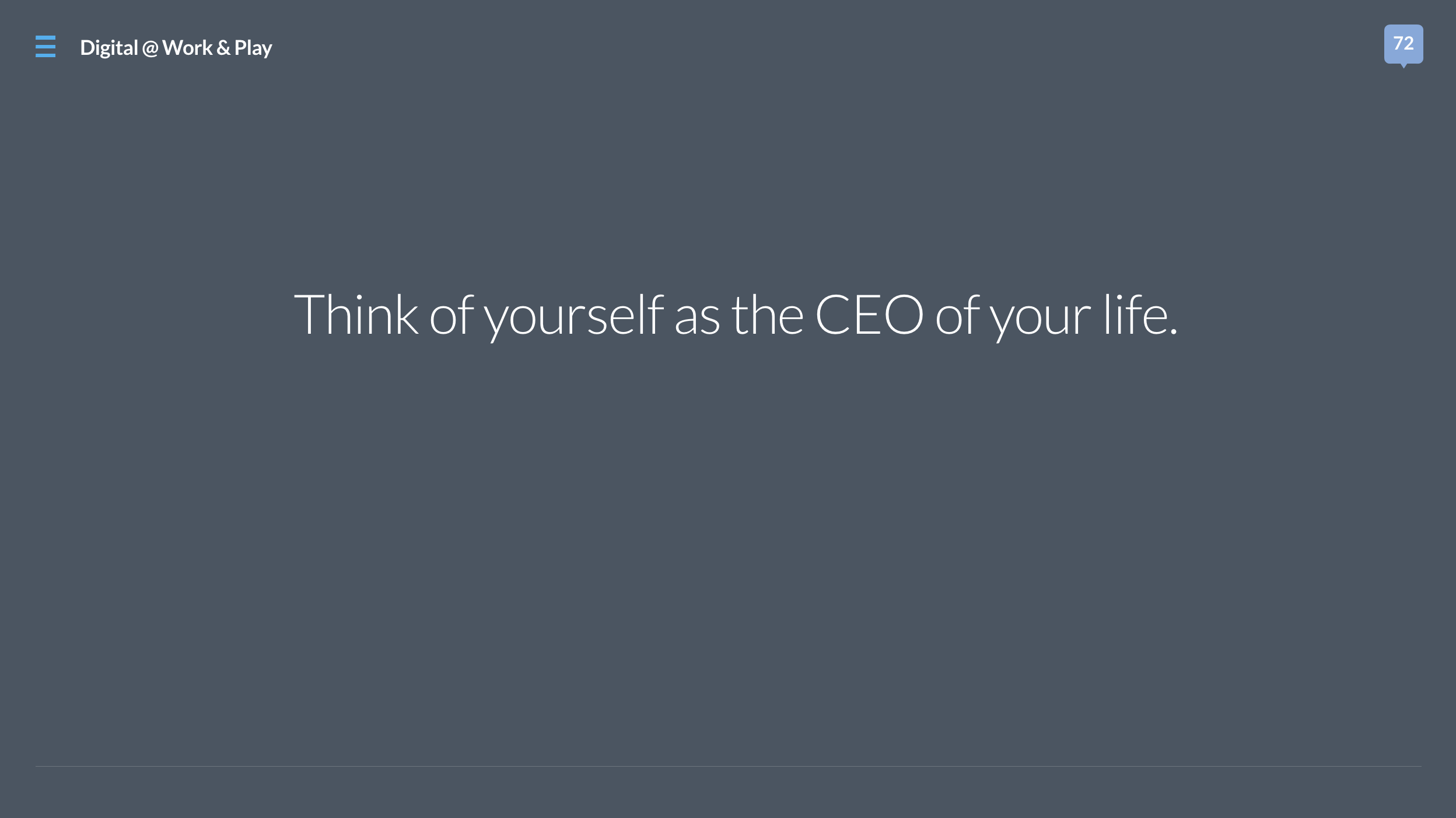
I’m not even really sure why I included this slide, but in retrospect I’m really glad I did. I have been thinking this way for a long time, as people who know me personally would attest.
I do think of myself as the CEO of my own life, and like I told the students, you should look back at the work of the CEO at year’s end and decide if the CEO deserves a contract extension or needs to be replaced. Based on the goals set at the start of the year, one’s age, and one’s personal circumstance is the CEO doing a good job? Is the CEO managing risk properly? Putting in contingency plans? Growing the business? Getting results? Or has the CEO missed some opportunities? Made some bad decisions that hurt the business?
It can be an eye-opening and often uncomfortable experience asking these questions of oneself if they’re considered honestly. In a way, this one slide could be more important than the other 84 combined, because it applies to everyone.
Overall I really enjoyed the session — the students were curious and it was great engaging them in discussions and helping answer their questions. I was a bit nervous preparing for such a long talk, but it went better than I thought it could. I’ve already been asked back to do it again for new students next semester, and I’m looking forward to it — particularly because I can recycle my deck! ????
I got a push notification on my phone a couple of weeks ago from Facebook, politely informing me that I hadn’t updated my status in a month and encouraging me to let my friends know what I’ve been up to. I had never received a message like that before, so clearly I had been good about updating enough or the social media giant was employing a new tactic to get people active again.
While the notification caught me off guard, it did confirm something I’d been feeling all along: I’m using the service less frequently. Facebook is very sneaky at getting attention and prompting people to open the app through various notifications, alerts, and badges, and it’s largely worked (for me, too). But time and time again, I’d open it up and begin scrolling through the newsfeed only to find low-level arguments about Trump and #fakenews, aspirational quotes, beach vacation photos, selfies, and more. I don’t begrudge anyone from posting these things, but I realized I wasn’t getting much value for my time. It was like consuming empty calories.
The fact is, it seems everyone is busy these days and time is tight. I can open Twitter to get the latest news (a piece on why Twitter is so much better than Facebook would be long and detailed, so I’ll save it for another day), Nuzzel, my RSS app-of-choice Reeder, or any of the subscriptions I have to news organizations like the New York Times or Washington Post. If I really feel like a dip in the social media pool, Instagram is a lightweight, simple, and fun way to see what people are up to.
I don’t know if I’m experiencing this in isolation, or if others are reaching the same conclusion. I have friends who have sworn-off Facebook in an act of defiance, angry about its invasion of privacy or because of some deep dislike of Mark Zuckerberg. I’m not in either camp; I just slowly began seeing less value to the point where I’ve stopped using Facebook and hardly even noticed.
I’ve decided to delete the app from my phone, as I can get whatever I need, if I need anything, through the mobile web (plus, Facebook fans, the official Facebook app is a major drain on your phone’s battery). I’ll continue to use the Messenger app, though. I’m also not sure yet if I’ll entirely deactivate my account, which seems like a giant leap into the abyss, as if I’m removing my name from the world’s phonebook. But for the time being, I’m happy without it. And plus, nobody needs empty calories.