Like many others, I’ve been deep inside AI world for the past several months. The launch of Claude Cowork, in particular, alongside the proliferation of MCP servers has opened up all kinds of potential. I hope to share some of these ideas in the future.
For now, here’s a simple daily news roundup that I find helpful: the AI Daily Brief.
I pay and subscribe to a few dozens newsletters – most on Substack – and subscribe to even more RSS feeds that focus on what’s happening in AI. The problem: I don’t have enough time, every day, to go through all that material in addition to all the work-related stuff I need to read. So I created an agent to compile a summary of the most important items.
To do so, I gave it access to my email and Substack subscriptions, as well as my folder of RSS feeds on Inoreader. So I’ve already curated the sources — AI is taking that and compiling a summary of the most important developments. I don’t want to miss anything, so I also asked the agent to do a general news search. Lastly, I provided it with a selection of tools I use (software like Obsidian, DEVONthink, and Craft) and asked it to share any new AI-related news or workflows that have emerged using these tools.
The result is an email that I get every morning, and a corresponding web page that I’m now sharing with the world here. It will publish at 9am daily Hong Kong time.
As always, I’m open to thoughts and suggestions to make this even better. So drop me a line, and let me know what you think.
One of my nerdier goals during the Christmas break has been cleaning up my messy and discombobulated news ecosystem. I’ve used RSS regularly for a long time, so that’s naturally picked up some cruft in recent years. Throw in a plethora of Substack newsletters and links scattered across various ‘read later’ apps, and you see the potential for some serious link chaos.
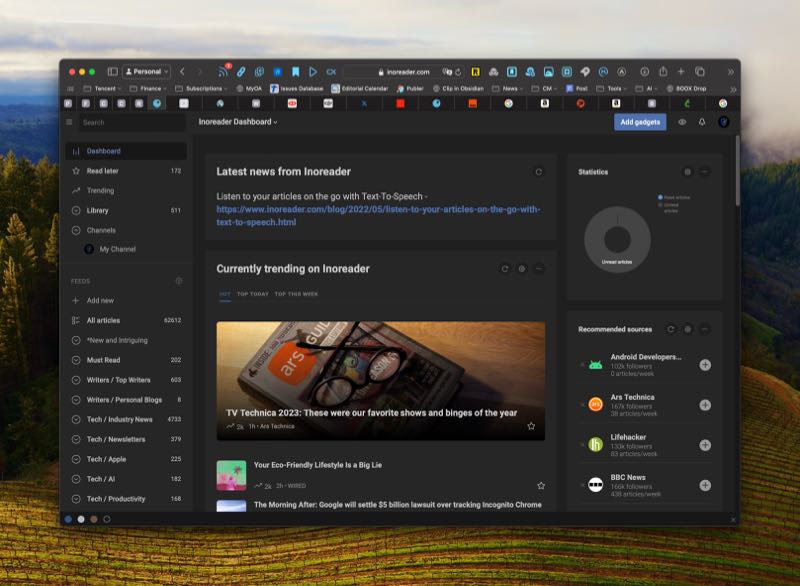
The first step was to clean up my feeds in Inoreader, which I’ve mostly done. Inoreader remains the most powerful RSS reader on the market, packed with features for power users. I make good use of the highlighter, rules, tags, and filters. I’ve even combined RSS feeds to create new ones that I can use elsewhere. If you just want to track a few blogs, Inoreader is probably overkill; but if you want to slice and dice through the information overload, Inoreader is among the best ways to do it.
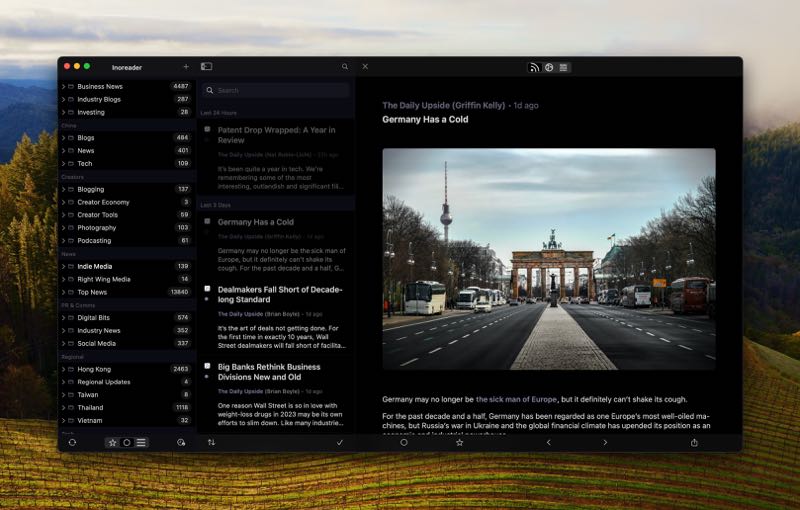
Several years ago I also loved Fiery Feeds, a boutique app available across Apple’s platforms. I remember loving the app, but running into bugs frequently enough that it soured on me over time. And to be honest, I’ve never quite felt right about RSS since then. So after I cleaned up Inoreader, I decided to connect it to the Fiery Feeds app on MacOS, iOS, and iPadOS and give it another shot — and I’m in love.
I had forgotten how clean and streamlined the app is. Fiery Feeds brings over saved searches, tags, and other features of Inoreader, while adding the ability to create “sections”, which can be groups of folders, feeds, or both. I’ve always wanted at least one or two levels down of nested folders, and this feature scratches that itch.
Fiery Feeds also offers granular control over how the app looks and functions, including text font and sizes across various different views, whether you want a one, two, or three-pane view, what left and right swipes will trigger, and which apps to integrate as sharing options. I’ve only started using Fiery Feeds again for the past few days, and so far it’s been totally bug free. Things are efficiently clicking along for me again for the first time in years. It’s lovely!
After I got everything up and running, I decided to dig into some more complex automations. For instance, I connected Zapier and the app Pushcut to deliver urgent notifications to my phone if a news article met a certain set of criteria. I also opened a Telegram Channel and automated a custom news feed directly into the channel, and so far it’s working great. If there’s any interest in how I’ve set this up, let me know below (or ping me on X, Mastodon, Threads, or Bluesky) and I can throw together a tutorial.
Next, sorting through the various ‘read later’ apps I’ve tried over the years, which now includes Goodlinks, Omnivore, Cubox, Anybox, Articles+, UpNext… (hey, for some people, trying every notes app is their thing — don’t judge)
David Roth is critical of Donald Trump, to be sure, but saves his most scathing critique for the journalists tasked with covering him, a view I share completely.
From The Cancer in the Camera Lens | The New Republic:
This is especially troubling because confusing and frightening things really are happening, every day. Thousands of Americans are dying, every day, from a disease that, as a quadruple-bylined survey in Science concluded, “acts like no pathogen humanity has ever seen.” For more than a month, state and federal leaders have edged up to suggesting that this is something the country might just play through, shedding thousands of lives every day in the name of the American Way and various industries’ bottom lines; states are already gearing up for this kamikaze response to an unreasoning virus. Trump is fixated on various numbers that he can watch go up or down and on not losing his reelection campaign; he fights to win the day because it’s all he knows and how he lives, and he’ll govern that way until he isn’t governing anymore. There is no leadership of any kind coming from the top of the government, and while it’s hard to say what the Democrats are doing, exactly, “leadership” surely isn’t the word for it. All of it, quite literally, is a matter of life and death. Right now, either out of instinct or inertia, the culture is tipping toward the latter.
And yet, as with the broken system that perpetually elevates what Trump says over what he does—the treacherous spectacle that puts him back in those presidential close-ups day after day—the obvious failure of it all has somehow not led to a change in course. The institutions that might help people understand a uniquely terrifying world instead turn, daily, back toward the uncomprehending pursuit of an idiot king’s vinegary whims. When a reporter from The Washington Post stammered out a question last week about Trump’s stance on disinfectant/sunlight injections, Trump was already leaning in, manifestly out over his skis and yet comfortably in his element. “I’m the president,” he said, “and you’re fake news.” Here is what he said after that: “It’s just a suggestion. From a brilliant lab, from a very very smart, perhaps brilliant man. He’s talking about sun, he’s talking about heat. And you see the numbers. That’s it, that’s all I have. I’m just here to present talent. I’m here to present ideas.” It’s not an answer, but it was enough to get him to the next question. Trump didn’t know the answer to that one, either, but someone was still waiting to ask it.
The media’s failure in this era is only matched by the President’s.
As a teenager, I always dreamed of working as a journalist. I loved
Enter The Correspondent, a five-year-old Dutch startup that refuses advertising dollars and makes building trust with readers its north star. I first heard about The Correspondent from media critic, blogger and professor Jay Rosen on Twitter; I read up, and just minutes later made a donation.

The Correspondent sets itself apart by publishing its ten founding principles, which contain promises to be transparent, always put journalism ahead of profit, and never run any advertisements. The goal is to raise enough money — $2.5 million, to be exact — to launch a US version of the publication and provide an alternative to the advertiser-driven,
A team from The Correspondent is now pounding the pavement to reach its fundraising target before the deadline in mid-December. I have no idea if they’ll be successful, or even if the final product will live up to expectations — but I applaud them for trying. We are living in a rapidly changing world in which trust in our institutions is eroding and the truth is becoming a matter of opinion. For the good of journalism — and the United States — I hope The Correspondent succeeds.
You can make a donation here.