Quartz reports the NBA-China spat draws global attention to Hong Kong protests:
Politicians from across the spectrum—from Ted Cruz to Alexandria Ocasio-Cortez—have warned the NBA not to compromise America’s respect for free speech and bend to China’s will. The Washington Post (paywall), the New York Times, and the Wall Street Journal (paywall) have advised the league in strongly worded editorials not to be complicit in Chinese censorship. The Daily Show‘s Trevor Noah devoted a segment to the NBA firestorm, with a pretty comprehensive list of China’s offense-taking in the last two years.
And basketball fans have added oil to the issue, as Hong Kongers might say, by taking protest messages directly to NBA games. Fans attending pre-season NBA games in the US have worn t-shirts or held up placards bearing messages of solidarity with Hong Kong, including during an exhibition game between the Washington Wizards and the Guangzhou Loong Lions.
China has a long history of bullying American companies, but this is different. China wants a major US company to punish an American-born citizen, who lives in America, for speech made while on US soil. And unlike other companies that have been forced to change their websites or pull products, the NBA is a company with millions of fans who follow its every move.
There are also few things Americans hold dearer than freedom of speech — it is one of the few issues left with bipartisan consensus, where Americans of different backgrounds and religions and socioeconomic status have common ground. Now millions of people — including millions of sports fans who previously knew nothing about the Hong Kong protests — have been galvanized in opposition to China and in support of freedoms in Hong Kong.
Make no mistake, this was a massive strategic blunder by China.
Hong Kong’s embattled government has announced plans to ban people from wearing masks at public assemblies, as it struggles to control the increasingly violent civil unrest gripping the city. Chief Executive Carrie Lam Cheng Yuet-ngor’s administration, under mounting pressure from its political allies to put a stop to nearly four months of anti-government protests, imposed the ban on Friday through legislation by invoking a tough, colonial-era emergency law that has not been used in more than half a century. Sources have said the new law could entail a jail term of up to one year or a fine of HK$25,000, and would apply to lawful assemblies as well.
Blocking traffic, throwing Molotov cocktails, setting fires, vandalizing MTR stations, and hurling bricks at police station windows are also illegal, so why would protesters suddenly obey this law?
Furthermore, police are usually badly outnumbered and struggle to arrest even the most violent of protesters. Why do they think they’ll be able to arrest potentially thousands more people illegally wearing masks?

Protesters take to the street in Central, Hong Kong, minutes after Chief Executive Carrie Lam announced the mask ban on 4 October.
The unrest in Hong Kong over the last two months has been all encompassing, dominating discussions at work and out with friends, while news coverages oscillates between showing the very best of Hong Kong (two million people marching through the city) and the very worst (violence). In some moments it seems like maybe things are looking up; other times one feels nothing but despair. One of my colleagues came into my office the other day and closed the door behind her, then began to cry. Several times close friends here have asked me if I will leave Hong Kong, and it breaks my heart.
I haven’t written much on here about the unrest because so many people are doing that already. I’m also not quite sure what to say — I live in Hong Kong, but it’s more than that: it’s home. I love it here; I love nearly everything about it. So this isn’t just some juicy news story, it’s impacting my life in many different and personal ways. Having said that, I’m among the luckiest ones because it’s relatively easy for me to pack up and head out — something very few of the seven million Hongkongers can do.
So I’m skippin’ town for a while.
Earlier this year I discovered a travel secret (well, a secret to me): Cathay Pacific award availability opens up quite remarkably during the week before departure. I had spent hours trying to figure out a way to get to North America by experimenting with airline awards programs and cities, but no combination worked well enough for me to take it. That changed last weekend, when several business class seats on Cathay opened up to New York City. It didn’t take long for me to snap one up.
I’m already looking forward to the 16 hour flight, because I’ll be able to turn off my electronic devices and read a magazine or book. In fact, if you’ve got some suggestions for some excellent fiction, please let me know in the comments. I’m always looking for something new. I’m not sure if I’m more excited about the flight, or the fact I’ll be in New York City! The truth is I think both are going to be great. I’m already slotting Sadelle’s and Katz’s into the itinerary.
I don’t have the foggiest idea of what to expect when I return to Hong Kong at the end of the month. I hope against all reason that some reasonable, middle ground is found that preserves what makes Hong Kong so special and gives hope to the next generation. Unfortunately that isn’t looking likely.
I’ll be following closely as events unfold.
Protests have rocked Hong Kong, where I live, since early June when one million people took to the streets in a peaceful march against a piece of legislation that, if passed, would have permitted the extradition of fugitives in Hong Kong to Mainland China.
I wasn’t born in Hong Kong, but I have lived here for over a decade. I bought my first home here. I have a Hong Kong Permanent Residence card, giving me nearly all the same rights as any other born-and-bred Hongkonger. I work here. I’ve built a professional and social network here. I’ve put down roots here. What I’m trying to say is Hong Kong is home and I care deeply about it, so watching the protests has been an emotional rollercoaster from inspirational to heartbreaking to fury, then back again.
That rollercoaster hit a new low last Sunday night, July 21. Following a protest in Sheung Wan, the neighbourhood I live in, protesters took the MTR metro service back to their home communities. Many protesters live in the rural areas of Hong Kong, including a village known as Yuen Long. The protesters, clad in black – part of the protester uniform here – arrived at the Yuen Long MTR station and were met by around 100 vicious men in white shirts who proceeded to violently pummel the mostly unarmed protesters. The attacks, the most violent so far, reached a depressing new low. I watched one particular video were a young man begged on his knees not to be hurt; he was shaking with fear, unarmed, and could very well have been a teenager. It was painful to watch. I don’t know when he eventually stepped out of the train car because the video ended shortly after a “white shirt” entered the train and punched him hard, in the face, knocking him right off his feet.
I’ve gotten softer as I get older, and I just couldn’t stomach watching more horrific videos. I know and work with people just like those who got off the train that night facing a bloody, terrifying scene, bracing themselves for violence.
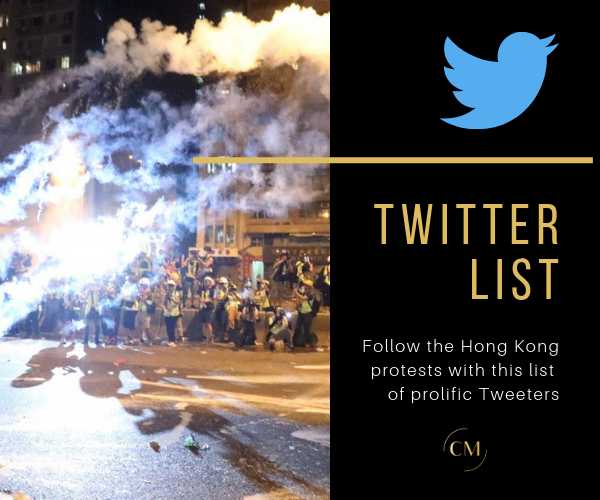
I did come to a very late to this realization though: the best content about the Hong Kong protests — both on-the-ground reporting during the clashes as well as political and economic impacts — is undoubtedly on Twitter, yet few people get to see it. Yes, some Tweets and videos get embedded into news stories from time to time, but that doesn’t nearly do the amount of “reporting” justice. The whole protest ecosystem is represented on Twitter, including protesters using both Chinese and English, the Hong Kong Police Force, journalists, professors, politicians, and other prominent members of society. Not having a Twitter account, or not knowing how to use it, shouldn’t be a barrier to information. Twitter can seem like a noisy, crowded space most of the time, but the reality is few people use it in Hong Kong and its global audience is a tiny fraction of the size of Facebook’s or Instagram’s.
I came across an excellent list of 100 people on Twitter to follow for coverage of the Hong Kong protests by the Taiwan Gazette. They did a fantastic job compiling it, so I’ve taken those names and created a list within Twitter so anyone on the social network can easily add it to their account. It also allows anyone, even those who have never used Twitter and don’t have an account, to follow along.
Links & Resources:
Twitter has crashed on me a couple of times, so if you spot a name missing from the list please give me a shout. I’m also wide open for suggestions, so if there’s somebody you think deserves a mention I’d be happy to add them.