When Tim Cook tried to explain away its actions this week by saying protesters were using HKmap.live to “maliciously to target individual officers for violence” without providing evidence, even longtime Apple observer and blogger John Gruber, couldn’t stomach it.
“I can’t recall an Apple memo or statement that crumbles so quickly under scrutiny,” Gruber wrote. “For a company that usually measures umpteen times before cutting anything, it’s both sad and startling.”
I completely agree with Gruber and the general tenets of this piece. US companies — and Hollywood, in particular — have been appeasing China for a long time in exchange for access to its giant market. This has mostly flown under the radar because it didn’t affect customers elsewhere — but that has changed with the NBA’s PR stumbles this week.
Apple had no justifiable reason for removing the Hong Kong protester app, and the internal email to Apple staff explaining the removal is downright embarrassing. I’m a long-time Apple customer who has spent tens of thousands of dollars at Apple stores over the past decade, but CEO Tim Cook’s decision to side with a dangerous, authoritarian government and against people asking for the very same rights Cook enjoys makes me never want to spend another cent with Apple again.
Hopefully Cook reflects on his own conscience and shows some sign that he believes his own rhetoric on human rights. If he doesn’t, Apple is going down a dangerous path.
I’ve never been more disgusted with Apple than I am today.
The iPhone and iPad have made computers accessible to people all over the world, both young and old. They’ve done away with the mouse and made interacting with apps much more natural, using touch. The result has been an explosion in apps, including some excellent productivity apps for the iPad in particular.
Apple is now trying to take some of that magic and bring it back to the trusty ol’ Mac.
The latest iteration of the Mac operating system, macOS Catalina, rolled out earlier this week alongside several apps making their debut on the Mac. Apple had previously released a new framework to developers called Catalyst, which makes it much easier for developers to take their existing iPad apps and move them to the Mac. The framework, announced in 2018, was met with some early skepticism after the first couple of Catalyst apps, like Apple News and Stocks, didn’t look great on the Mac. In fact, some were concerned that bringing apps designed for a touch interface to a keyboard-and-mouse old school computer might be an awkward fit, making the Mac less streamlined and consistent.
It’s still probably too early to call Catalyst a success, but early returns are looking positive.
As a guy whose life revolves around RSS feeds, seeing Fiery Feeds in the Mac App Store probably got me far more excited than I should be. Someday I will do a deep dive into the combination of Inoreader and Fiery Feeds, which does an excellent job of filtering and tagging important articles. Reeder has traditionally been the standard-bearer for RSS apps on the Mac, with version 4 coming out in April, but the addition of Fiery Feeds and Lire will certainly shake things up. I use Fiery Feeds multiple times a day on my iPad and iPhone, so having everything sync via iCloud and being able to check new articles while on the Mac is huge.

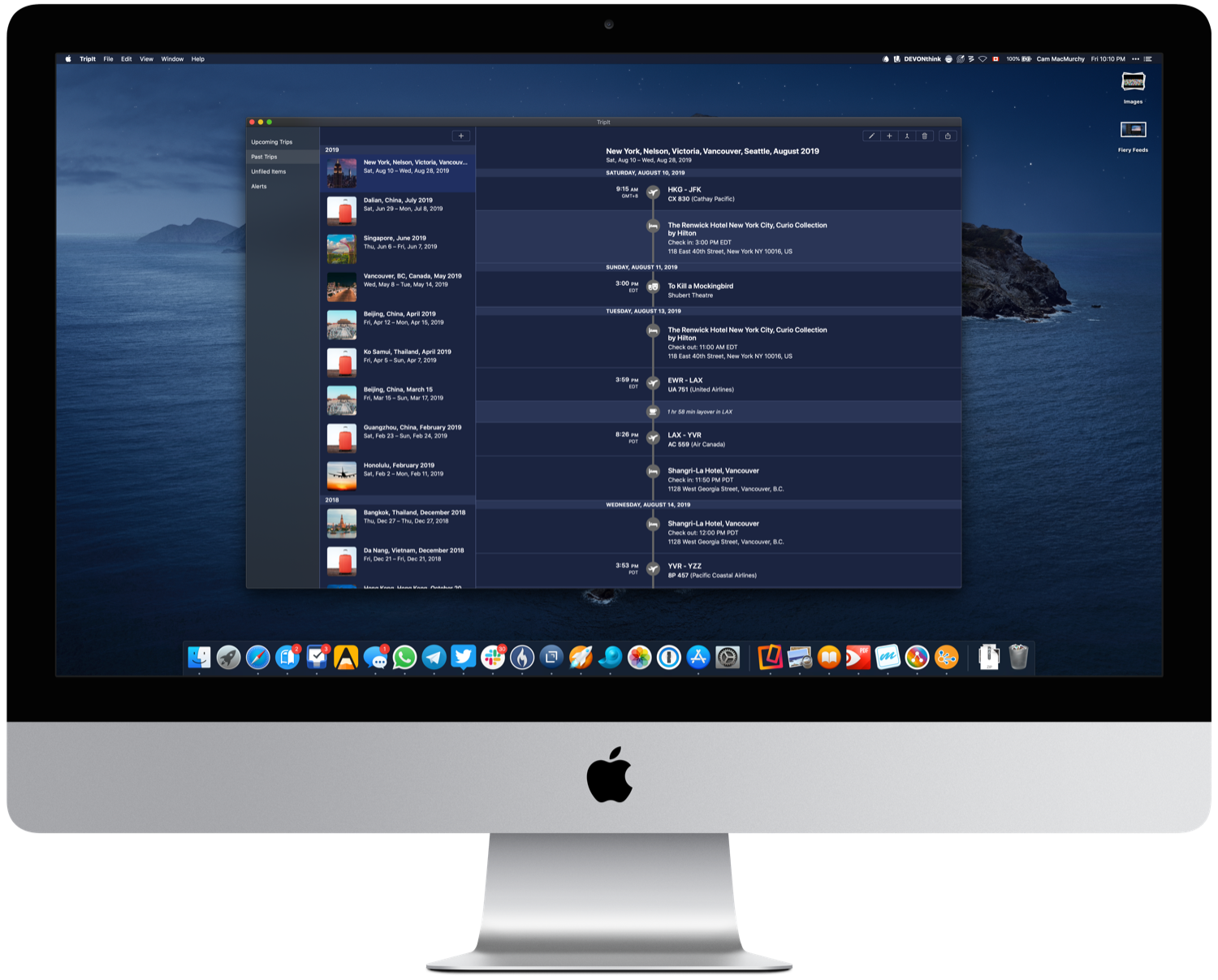
Another app with a big, dedicated user base is TripIt. I began subscribing to TripIt Pro a couple of years ago to help manage travel, and it has generally made keeping flight and hotel information as well as confirmation numbers easily accessible and in one place. I think the app’s UI is a bit dated, but functionally it’s been successful at what it sets out to do.
TripIt’s new Mac app doesn’t bring any surprises, and that’s probably a good thing. It provides all of the same information as the iOS app, but from the desktop.
I have only been testing out Catalyst apps for a few days, and there are still some rough edges that need to be smoothed out. Right clicking is common on the Mac but not on an iPad, obviously, so right clicking sometimes does nothing. I’ve also had each Catalyst app crash on me at least once, so there’s that, too.
Another thing to consider is the price — some of these apps probably cost more than you would expect. I think it’s high time that developers are compensated fairly for their work, so I have no particular issue with paying higher prices — but it will impact sales, regardless. Cocoacake, the maker of Fiery Feeds, is charging US$34.99 for the Mac app, justifying the price on the company’s blog by saying it’s a one-time cost that will cover the next three to five years of app updates. Lire is listed at $19.99.
I suspect performance issues to be worked out over time as more developers use Catalyst and Apple continues making improvements. Even today, in the early days, it’s encouraging to see so many developers embrace Catalyst and have apps ready on day one. If you want to see if your favorite iPad app is ready for the Mac, you can check this handy list put together by 9to5Mac.
If the launch of these early apps is any indication, it looks like a safe bet that Catalyst will breathe some new life and a bit of excitement into the Mac app ecosystem.
After we shut down The Nanfang in late 2016, we decided to take a break. I stepped away from web publishing, marketing, social media scheduling, analytics, WordPress updates, and all the things that go along with running a website that is updated multiple times per day. It was a nice break, and only recently I’ve begun to drift back into that world — this personal blog being the best example.
The cool thing now is I’m not writing to grow an audience or become an “influencer” or sell ads. Actually, if nobody reads this I’d probably be okay with that! Writing, on some level, is cathartic, and the act of putting words together and publishing them online is reward enough. I’m eternally grateful to those who stop by and enjoy reading.
In the last few weeks, it occurred to me that I could pitch in by writing about subjects I love to write about, maybe even on other websites. I’m no longer a freelancer desperate for a paycheck or exposure — I would be doing it solely for the love of writing about things I care about. So a few emails later, I’m happy to announce I’m now an official contributor to 9to5Mac.
I have been a fan of Seth Weintraub’s websites, of which there are many, for almost ten years. They have taken up permanent residence in my RSS reader and are usually the first feeds I click on. (I highly recommend this write-up in Business Insider, looking at how Weintraub got his start and built a tech journalism empire.) I have a ton of respect, in particular, for 9to5Mac, which has become the go-to website for Apple news, reviews, tips and more. Some who got their start at 9to5Mac, most notably Mark Gurman, have left to high profile positions in the journalism industry.
My first article on the dual-SIM Hong Kong version of the iPhone XS Max went live this week, and they just published another little ditty on WeChat stickers. I’ve already received plenty of feedback internally and from readers, which is great. I haven’t met everyone on the 9to5Mac team yet, but so far they have all been incredibly gracious and welcoming. It seems like a great group, and I’m super optimistic about working with them. I will probably post my 9to5Mac articles on my Facebook page, but if you’d like to follow along the RSS feed is here. (Though I encourage you to subscribe to the full feed because everyone on staff is churning out great stuff.)
If you have ideas for stories, please let me know! I’m happy to say I can now be reached at cam-at-9to5mac-dot-com.
We must never turn away from the truth, no matter how uncomfortable it might make us.
Which brings us to Apple and an app called Metadata+. The app was first released in 2014 and provided a very simple service to users: it sent a push notification anytime a US drone strike resulted in a death. It was downloaded 50,000 times before Apple decided to pull the plug, saying the content of the app was “objectionable and crude.”
Josh Begley, the creator of the app, has been trying periodically to get it back into the Apple App Store since, and was successful for a few hours this week before Apple noticed and pulled it again.
Begley’s app should be allowed in the App Store, and Apple should be ashamed by its stance. Begley’s app shines light on one of the more controversial aspects of an ongoing war, one that people have the right to know. There were no graphic depictions of death in Begley’s app; no blood and gore; nothing violent at all. Instead, it was a real-time news service about something all Americans – and everyone everywhere – should be informed of.
In an era in which technology companies like Facebook, Google and others have tremendous influence over the information people receive, all companies have an obligation to ensure that users can access accurate, truthful information, particularly information which involves the actions of their own government. Blocking access to vital information makes Apple no better than the worst censors operating in authoritarian regimes.